
Memorandum of Intent Template
A memorandum of intent records what two or more parties plan to do before they sign a full agreement. Fill in the parties, purpose and main points, choose which clauses are binding, and the template drafts a clear, well-structured memorandum you can print, copy or download as a Word-compatible file for your lawyer or the other party to review.
- Free to use
- No sign-up
- Runs in your browser
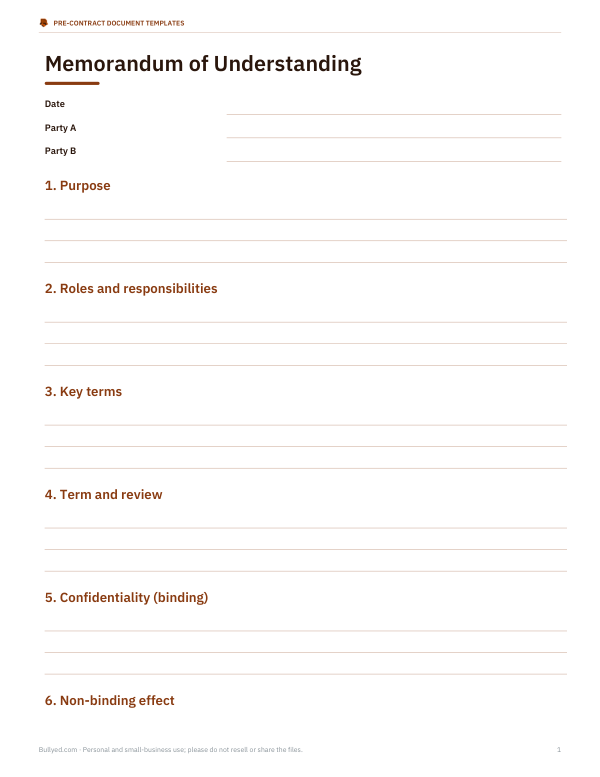
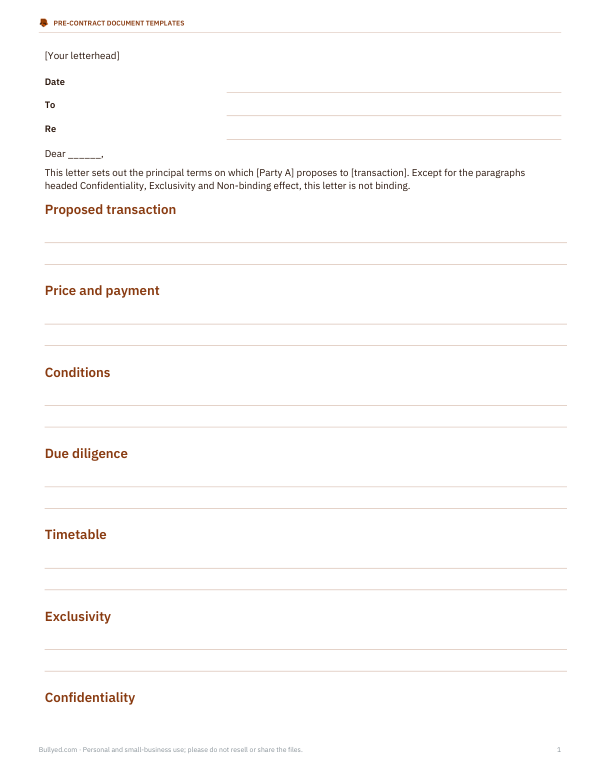
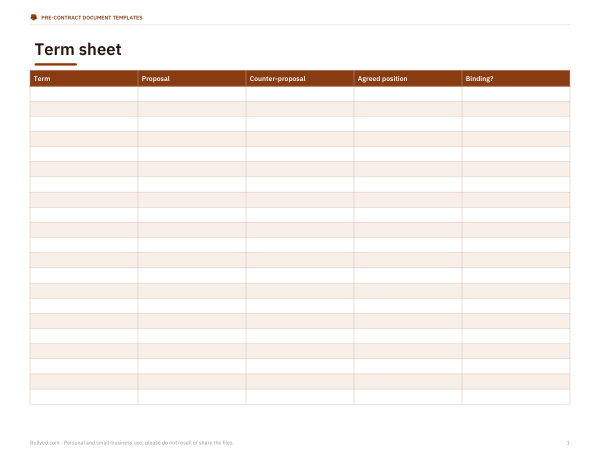
Memorandum of intent drafter
Pre-Contract Document Templates
Editable Word templates for a memorandum of understanding, letter of intent, term sheet and mutual non-disclosure agreement, with a negotiation tracker and signing checklist.
- MOU template (DOCX)
- Letter of intent (DOCX)
- Term sheet (DOCX, XLSX)
- Mutual NDA (DOCX)
- Signing checklist (PDF, DOCX)
Formats: DOCX, PDF, XLSX. Instant download after payment (link valid 72 hours, up to 5 downloads). AI-assisted: the templates were drafted with AI help and reviewed and laid out before publishing.
$5.00 USD, one-time 5 files · about $1.00 each
- Instant download
- 7-day refund
- Secure checkout by Stripe
7-day money-back guarantee. Full refund within 7 days of purchase, even after you download.
Free sample: Letter of Intent (PDF, 57 KB)
Full refund within 7 days — see the refund policy and license.
Free printables
Single sheets you can print right now, no sign-up. The full pack adds every sheet in one download plus the editable files.
 Mutual NDA Template PDF
 Memorandum of Intent Signing Checklist
What a memorandum of intent is
A memorandum of intent (MOI) — also called a memorandum of understanding (MOU) or, in letter form, a letter of intent (LOI) — is a short document in which parties set out the main points of a deal or collaboration they intend to pursue. It comes before the detailed contract. It helps both sides check they agree on the essentials, gives a framework for negotiations and due diligence, and records practical commitments such as confidentiality while talks continue. MOIs are used for business partnerships, supply arrangements, joint ventures, acquisitions, leases, research collaborations and agreements between organisations such as schools, charities and public bodies.
Binding or non-binding?
Most memoranda of intent are intended to be non-binding on the main deal: either party can walk away before a definitive agreement is signed. At the same time, some clauses are usually meant to be binding — typically confidentiality, exclusivity (no-shop), costs, governing law and the clause that says the rest is non-binding. Courts look at the words used and how the parties behaved, so the document should say clearly which parts bind and which do not. The template does this in its “Non-binding effect” section and updates the list of binding clauses automatically when you switch options.
What to include
| Section | Content |
|---|---|
| Parties | Full legal names, entity types and addresses |
| Purpose | What the parties intend to do together |
| Key terms | The main commercial points: scope, quantities, price approach, timeline, roles |
| Definitive agreement | The intention to sign a full contract, and a target date |
| Exclusivity | Whether either party may negotiate with others, and for how long |
| Confidentiality | Protection for information shared during talks |
| Costs | Who pays for lawyers, due diligence and other expenses |
| Non-binding effect | Which clauses bind and which do not |
| Governing law | Which jurisdiction’s law applies |
| Signatures | Authorised signatories for each party |
MOI vs MOU vs LOI vs contract
| Document | Typical use | Binding? |
|---|---|---|
| Memorandum of intent | Records intent to pursue a transaction | Mostly non-binding, with some binding clauses |
| Memorandum of understanding | Common for partnerships between organisations and public bodies | Often non-binding; some MOUs are intended to bind |
| Letter of intent | Letter form, common in acquisitions, leases and hiring | Mostly non-binding |
| Term sheet | Bullet list of deal terms, common in investment | Mostly non-binding |
| Contract / definitive agreement | Full, detailed terms | Binding |
The names are used loosely; what matters legally is the content and wording, not the title.
Worked example
A coffee roaster and a community market want to explore a wholesale supply arrangement. They list the key points — up to 200 lb of coffee a month, pricing to be set in a schedule, a dedicated shelf display and an initial 12-month term — choose a binding confidentiality clause and a costs clause, set no exclusivity, and target a definitive supply agreement within 60 days under Maine law. The template drafts eight numbered sections and signature blocks; both parties review it, and the roaster downloads the Word-compatible file to send to its lawyer.
Tips for drafting
- Keep it short — two or three pages. Detail belongs in the definitive agreement.
- Use “intend”, “propose” and “would” for non-binding points; avoid “shall” and “agree to” except in binding clauses.
- Name the authorised signatories and their titles.
- Include a target date so talks do not drift.
- If exclusivity matters, give it a fixed end date.
- Keep copies of the signed memorandum with your negotiation records.
When to get legal advice
For significant transactions — buying a business, property, investment, employment of senior staff, or anything involving large sums or regulatory approval — have a lawyer review the memorandum before signing. Even a “non-binding” document can create obligations or be used as evidence of what was agreed. This template is a drafting aid, not legal advice, and the law differs between states and countries.
After the memorandum is signed
Once signed, the memorandum becomes the roadmap for the next stage. Share it with the people who will negotiate the definitive agreement, run due diligence or prepare the operational plan, and put the target date and any exclusivity end date in your calendar. If discussions change a key term, update the parties in writing rather than letting the memorandum and the negotiations drift apart; if talks end, confirm it in writing and return or destroy confidential information as the confidentiality clause requires.
Downloading and editing
The download button saves a Word-compatible .doc file that opens in Microsoft Word, LibreOffice and Google Docs (after upload), where you can edit the wording, add a logo or letterhead and track changes with the other party. The print button produces a clean page you can save as PDF.
Privacy
The memorandum is drafted in your browser. Party names and terms are not uploaded or stored.
Frequently asked questions
Is a memorandum of intent legally binding?
Usually not for the main deal, but clauses such as confidentiality and exclusivity are often intended to bind. The wording decides.
What is the difference between an MOI and an MOU?
They are very similar; MOU is common for partnerships between organisations, MOI for intended transactions. Content matters more than the title.
Who should sign the memorandum?
People authorised to act for each party, such as directors, officers or managing members.
Can I edit the document in Word?
Yes, download the .doc file and open it in Word or a compatible editor.
Is this legal advice?
No. It is a drafting template; consult a lawyer for significant transactions.
Is my information stored?
No, everything stays in your browser.
Can a memorandum have more than two parties?
Yes. Add each party’s details and signature block; the structure works the same way.